In Sarawak, heritage is not just about relics of the past it a living, breathing legacy shaping the present and guiding the future. As modern development continues to advance across the state, the challenge lies not in choosing between heritage and progress, but in bridging the eras harmoniously.
The Problem: Modernisation Threatens Cultural Continuity
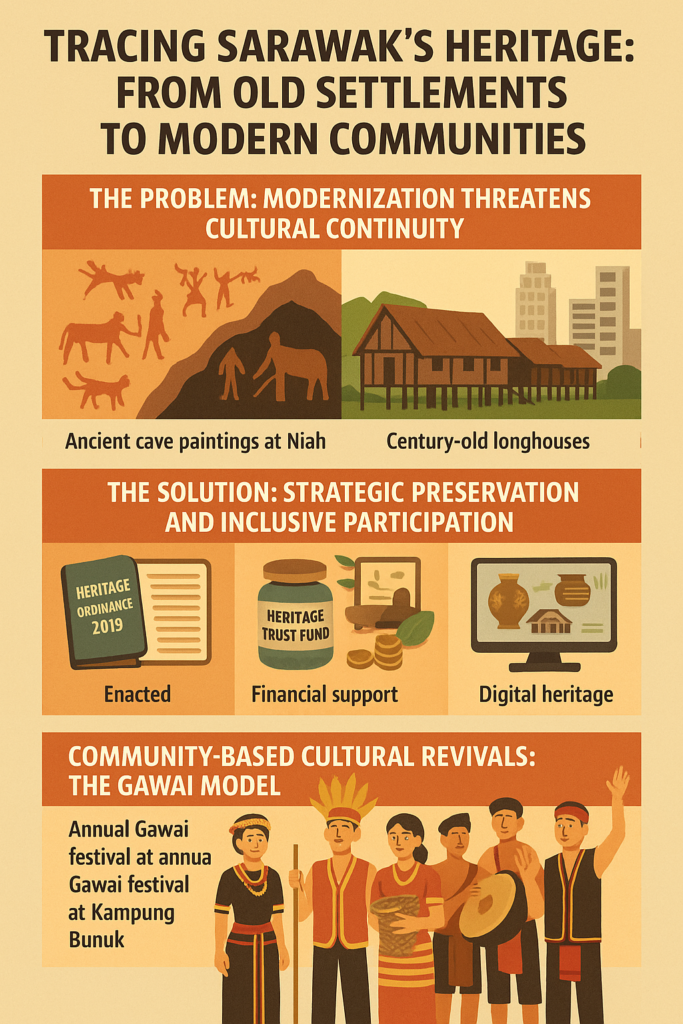
With rapid urbanisation and infrastructure development, many old settlements, traditional practices, and historical structures face the risk of being forgotten or replaced. From ancient cave paintings in Niah some dated to over 40,000 years ago to century old longhouse and rituals like the Iban miring, Sarawak’s tangible and intangible heritage are vulnerable.
As of 2024, Sarawak has more than 120 gazetted heritage sites, encompassing forts, caves, old buildings, and cultural landscapes under the care of the Sarawak Museum Department. Yet many more remain undocumented or unprotected.
Sarawak Museum Department Deputy Director Dayang Morzanah Awang Haddy warns that without proper conservation, these legacies could vanish. “We do not simply gazette and abandon the building, remembering it only when it is dilapidated,” she explained. “We ensure consistent inspections and maintenance so that heritage sites remain alive and relevant”.
The Solution: Strategic Preservation and Inclusive Participation
To counter the threat of cultural erosion, Sarawak enacted the Sarawak Heritage Ordinance 2019, Which officially came into effect on March 1, 2022. This landmark ordinance defines heritage broadly from historical buildings and cultural expressions to underwater artefacts and individual who embody traditional knowledge.
A Sarawak Heritage Trust Fund, established in January 2021, further strengthens conservation efforts by supporting restoration, documentation, and awareness activities. Between 2020 and 2023, the state allocated RM 50 million for these initiatives.
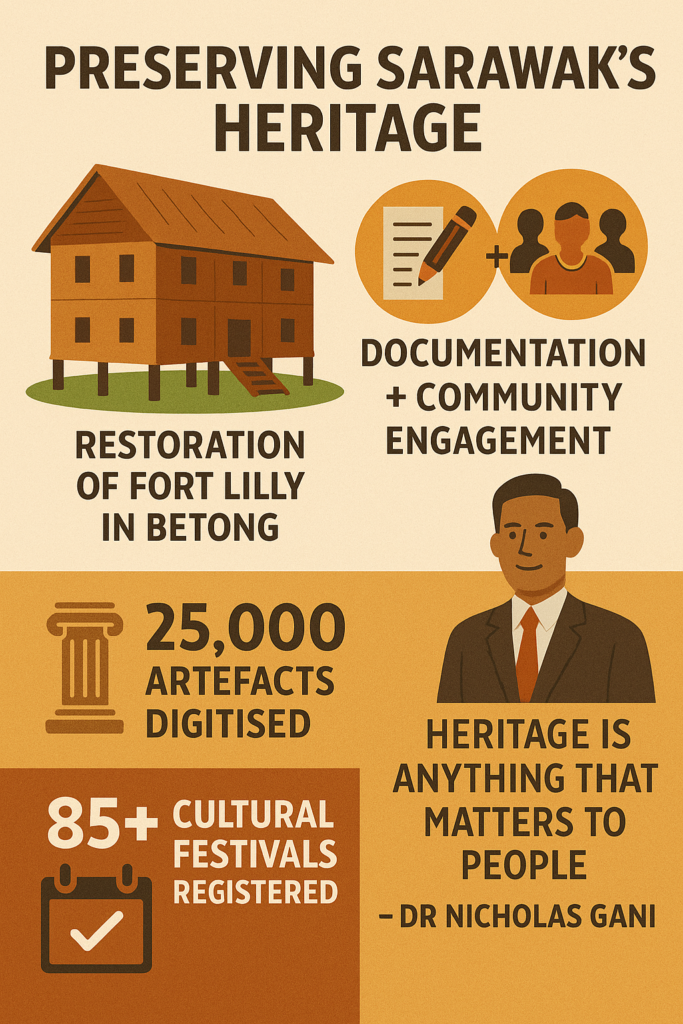
Dr Nicholas Gani of UNIMAS elaborates, “Heritage is anything that matters to people something they want to remember or use to define their identity. “He emphasizes that beyond physical preservation, documentation in audio, video, and written form is crucial to sustaining memory, documentation in audio, video, and written form is crucial to sustaining memory. To date, over 25,000 artefacts and 3,000 hours of oral history recordings have been digitised under Sarawak’s Digital Heritage Initiative.
One example of this multidimensional approach is the ongoing restoration of Fort Lily in Betong. The fort, a relic from the Brooke era, is being repurposed into a community museum, telling the story of Betong’s people. “We are not glorifying colonial legacies,” Dayang Morzanah clarified. “ Instead, we use these structures to educate and reconnect communities with their past.”
Community Based Cultural Revivals: The Gawai Model
Beyond formal ordinances and state level efforts, grassroots initiatives play an essential role in preserving living heritage. A prime example is the Brarak & Bipajak Gawai Bisegu festival at Kampung Bunuk, held on June 3, 2023. This event united six sub villages under the umbrella of Kampung Bunuk, bringing together over 500 villagers young and old in traditional Bidayuh attire to celebrate their shared heritage.
Despite a heavy downpour, the procession went on. “We wanted to strengthen harmony among the six villages,” said Gabriel Michael Tomi, chairman of the Persatuan Segu Bunuk Penrissen (PSPB). The overwhelming turnout and enthusiastic participation of the youth proved that cultural pride is alive and well.
As of 2024, more than 85 community-based cultural festivals are registered throughout Sarawak, strengthening intergenerational bonds and identity.
Young participants shared that they joined not out of obligation but passion. “It was fun and meaningful. I told my friends and siblings to come along,” said one youth volunteer. Seniors beamed at the sight of younger generations embracing tradition. Their joy underscored a vital point: heritage preservation works best when communities take ownership.
Sustainable Tourism as a Heritage Ally
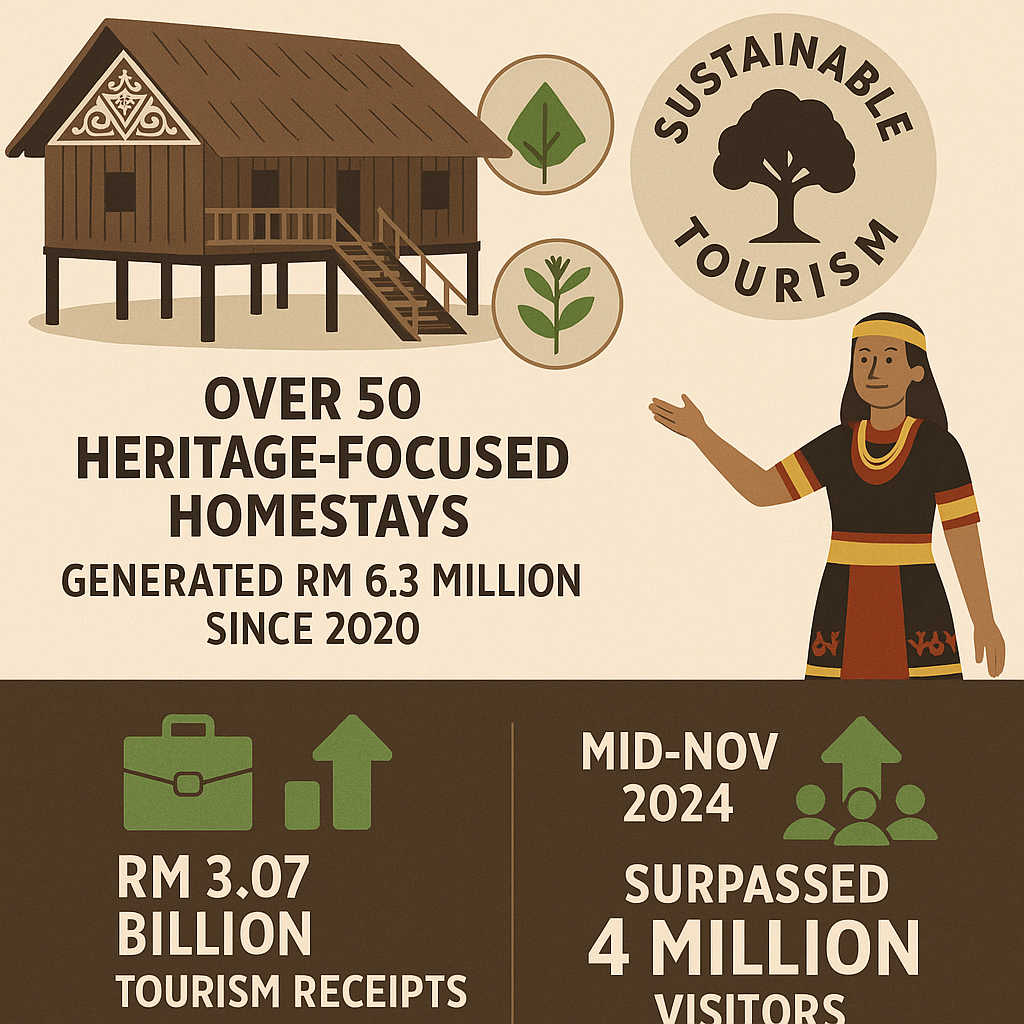
Cultural preservation is also being driven through sustainable tourism initiatives, many of which are supported by the Sarawak Tourism Board (STB). The Uma Belor Leo Dian longhouse in Sungai Asap, Bintulu showcase traditional Kayan architecture and is listed under the national Homestay programme. These heritage-based destinations not only safeguard traditional knowledge and architecture but also generate income for rural communities. As of 2024, over 50 heritage-focused homestays have collectively generated RM 6.3 million since 2020.
Sarawak’s cultural tourism has proven economically significant:
– In Q1 2024, the state recorded 1.18 million visitors, generating RM 3.07 billion in tourism receipts 31.2% increase compared to the same period in 2023.
– By mid-November 2024, Sarawak surpassed 4 million visitor arrivals, beating its annual target. For 2025, the state aims for 5 million tourists and RM 12.73 billion in revenue.
– For 2025, the state aims for 5 million tourists and RM 12.73 billion in revenue.
As Dr Nicholas pointed out, heritage include natural wonders like Gua Mulu, cultural Practices, and even individuals such as Master Weaver Bangie Embol, a pua kumbu craftwoman awarded by UNESCO. Recognising people as living heritage helps maintain pratices that might otherwise be lost.
The Role of Regulation, Expertise, and Innovation
What sets Sarawak apart is its structured, expert led approach to conservation. Under the Ordinance, restoration projects undergo through assessments. Certified conservators produce detailed dilapidation reports before any work begins covering everything from roofing materials to architectural authenticity.
“When restoring, we must respect the original form,” Dayang Morzanah stressed. “If it didn’t use nails, we don’t add nails. If the roof used belian wood, we replace it with belian.”
In addition, the Sarawak Heritage Council, a body of multidisciplinary experts, provides the state government with diverse perspectives on heritage issues ensuring that no single voice dominates the conversation.
The Bigger Picture: Identity, Memory, and Belonging
Preserving heritage is not about resisting change. Rather, it’s about embedding memory and identity into the heart of progress. “Heritage is a gift from the past,” Dayang Morzanah reflected. “It tells the story of who we were and how we can to be.”
As Sarawak balances development with cultural continuity, its approach offers a model for other regions. Through legal frameworks, expert stewardship, community empowerment, and tourism innovation, Sarawak is proving t
hat modernity need not erase memory it can amplify it.
Conclusion: The Future of the Past
Heritage may be old, but it is not obsolete. It breathes through the songs sung during Gawai, the intricate patterns of pua kumbu, the proud stance of an ancient fort, and the laughter echoing through longhouses. Each of these tells a story and together, they narrate the journey from old settlements to modern communities.
In preserving this past, Sarawak is not just remembering. It is building a future that honours its roots and strengthens its identity for generations to come.
Reference
BP Editor 10. (2024, October 20). Embrace cultural heritage through traditional exchanges, Sarawak youths told. Borneo Post Online. https://www.theborneopost.com/2024/10/20/embrace-cultural-heritage-through-traditional-exchanges-sarawak-youths-told/
Mail, M. (2024, September 27). Sarawak immersive offering: This is Malaysia’s tourism future — Khairul Anwar Zulkifly Tony. Malay Mail ; Malay Mail. https://www.malaymail.com/news/what-you-think/2024/09/27/sarawak-immersive-offering-this-is-malaysias-tourism-future-khairul-anwar-zulkifly-tony/151762
Tawie, P. (2022, August 22). Bridging the Eras. Sarawak Tribune. https://www.sarawaktribune.com/bridging-the-eras/