

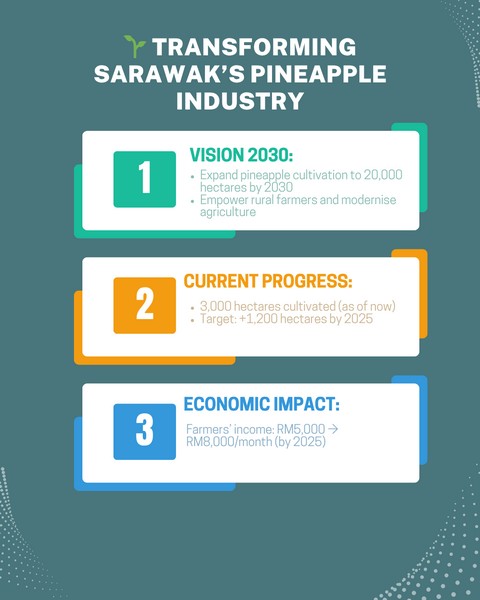
When Sarawak announced its ambitious goal to expand pineapple cultivation to 20,000 hectares by 2030, it was more than just an agricultural target it was a vision to transform livelihoods, modernise rural economies, and position the state as a leading producer of premium tropical fruits.
Challenges and a New Beginning
Since the Malaysian Pineapple Industry Board (MPIB) began operations in Sarawak in 2010, approximately 3,000 hectares have been developed for pineapple cultivation. Yet, this figure remains modest compared to the state’s vast and fertile potential. Strengthening the Pineapple Cluster Development Project has therefore become central to Sarawak’s new agricultural strategy.
Sarawak Premier Datuk Patinggi Tan Sri (Dr) Abang Haji Abdul Rahman Zohari bin Tun Datuk Abang Haji Openg, in a speech text delivered by Deputy Minister of Food Industry, Commodity and Regional Development Datuk Dr Abdul Rahman Ismail during the Sarawak Pineapple Industry Seminar 2023, emphasised that expanding the cluster is not just about increasing acreage it is about improving rural incomes and building resilient farming communities.
“By 2025, we are targeting an additional 1,200 hectares of new pineapple areas and increasing yield productivity from 40 to 50 metric tonnes per hectare. Farmers’ incomes are projected to reach RM8,000 per month,” he said.
This marks a significant improvement from the current average of about RM5,000 monthly, proving that the pineapple industry has the potential to become a stable and profitable income source, particularly for rural communities.
Solution-Oriented Approach: Clusters and Innovation
Through a solution journalism lens, this initiative addresses key agricultural challenges including over-reliance on traditional crops, market limitations, and low productivity caused by conventional farming practices.
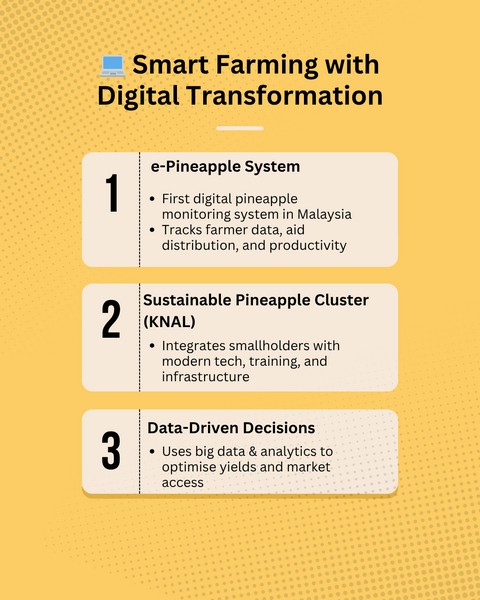
In collaboration with MPIB and related agencies, the Sarawak government introduced the Sustainable Pineapple Production Cluster (KNAL) model, which integrates smallholders into a structured ecosystem. These clusters enable access to modern technology, coordinated training, and improved infrastructure such as farm roads, irrigation systems, and storage facilities.
Productivity growth is further supported by the digitalisation of agriculture, marked by the launch of the e-Pineapple system making Sarawak the first state in Malaysia to implement such a platform. The system allows project monitoring, farmer data collection, and aid distribution to be carried out transparently and efficiently.
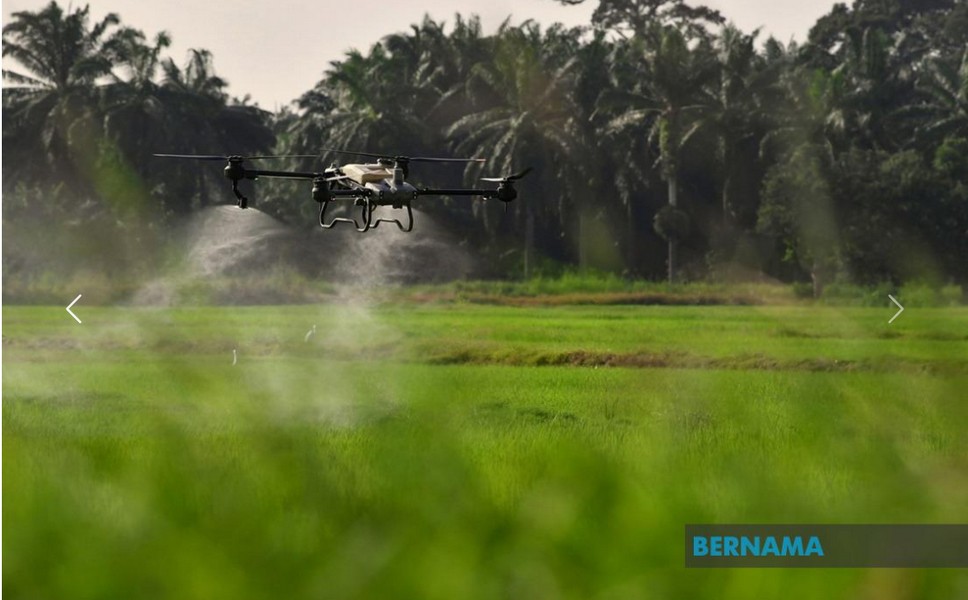
Minister of Food Industry, Commodity and Regional Development, Dato Sri Dr Stephen Rundi Utom, described this digital system as evidence of Sarawak’s readiness to lead the digital transformation in agriculture.
“Through the use of big data and analytics, we can make more accurate decisions from farm management to product processing. This is a clear example of how innovation can empower traditional industries,” he said.
Investment and Strengthening the Value Chain
A critical component of the pineapple cluster development is ensuring a complete value chain from cultivation to processing and export. Several initiatives have been launched to strengthen market access and enhance industry competitiveness.
Among them are plans to build a pineapple processing plant in Miri, which will provide a guaranteed market for farmers, and the Tanjung Manis Pineapple Hub, which has attracted RM1 billion in foreign investment. These facilities are expected to drive large-scale production and position Sarawak as a regional leader in pineapple exports.
According to Datuk Jeyarajan Sri Ramalu, Managing Director of JG Sarava Sdn. Bhd., the Tanjung Manis project will serve as a direct marketplace for pineapple growers across the state.
“Farmers will no longer need to rely on roadside or supermarket sales. They just have to deliver their produce to Tanjung Manis we’ll take care of the rest,” he explained.
Supporting infrastructure such as the Pan Borneo Highway also plays a vital role in improving logistics efficiency, enabling faster and more cost-effective transportation of agricultural produce a key advantage in regional competitiveness.
A New Variety: SG-1 ‘Sarawak Gold’
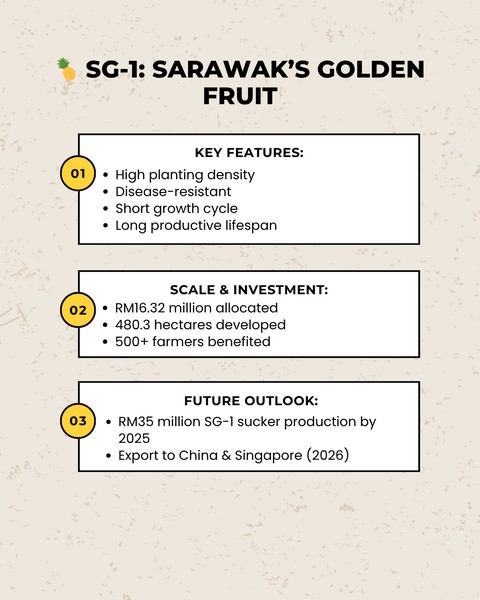
Sarawak has also introduced a new pineapple variety known as SG-1 (Sarawak Gold 1) the result of local research and development efforts. This variety features high planting density, strong disease resistance, shorter maturation time, and a longer productive lifespan.
A total of RM16.32 million has been allocated to develop 480.3 hectares of pineapple farms, benefiting more than 500 farmers across the state. In Miri alone, 30 hectares have already been planted with SG-1, with an additional 20 hectares planned for development by 2025.
Collaboration between the Sarawak Farmers’ Organisation (PPNS) and private companies has been established to produce SG-1 pineapple suckers valued at RM35 million by 2025. Additionally, a 2,200-hectare commercial pineapple farm is being developed in Tanjung Manis, Mukah, which will serve as a major production centre for the SG-1 variety.
At the same time, Sarawak is projected to begin exporting SG-1 pineapples to China and Singapore by 2026 a milestone achievement that will elevate the state’s reputation as a premium tropical fruit producer.
Socioeconomic Impact and the Road Ahead
The pineapple cluster development initiative does more than boost agricultural yields it strengthens rural economies and reduces income inequality. This comprehensive approach aligns with the Post-COVID-19 Development Strategy (PCDS) 2030 and the 13th Malaysia Plan (13MP), which emphasise smart, sustainable, and high-impact agriculture.
To date, over 500 farmers in Sarawak have received RM22 million in MPIB incentive aid, including planting materials, farm infrastructure, and research support. As a result, farmers cultivating the MD2 pineapple variety are now earning nearly RM9,000 per month, surpassing the income target set under the 12th Malaysia Plan (12MP). Under the upcoming 13MP, the target will be raised to RM10,000 monthly income per farmer.
“The pineapple cluster development does not only promise lucrative yields but also cultivates a knowledgeable, efficient, and competitive farming community,” said Dr Rundi.
Conclusion
With a clear direction, multi-agency support, and active community participation, Sarawak’s Pineapple Cluster Development Project stands as a model of modern, solution driven agriculture combining digital innovation, strategic investment, and rural empowerment.
From the farmlands of Miri to the export hub in Tanjung Manis, Pineapples now represent more than just an agricultural commodity they symbolise Sarawak’s socio economic transformation, where innovation and inclusivity go hand in hand to boost productivity, raise incomes, and build a prosperous future for all.
Reference
BP 3. (2025, July 24). Sarawak leads digital transformation with e-Pineapple system. Borneo Post Online. https://www.theborneopost.com/2025/07/24/sarawak-leads-digital-transformation-with-e-pineapple-system
News – M-FICORD Official Website. (2023). Sarawak.gov.my. https://mficord.sarawak.gov.my/web/subpage/news_view/1295
News – M-FICORD Official Website. (2024). Sarawak.gov.my. https://mficord.sarawak.gov.my/web/subpage/news_view
Tanjung Manis To Become Sarawak’s Pineapple Hub With RM1 Bil Foreign Investment | Sarawak Tribune. (2025, May 26). New Sarawak Tribune. https://www.sarawaktribune.com/tanjung-manis-to-become-sarawaks-pineapple-hub-with-rm1-bln-foreign-investment/
TFNet News Compilation. (2025, August 26). MALAYSIA: Sarawak To Start Exporting SG-1 Pineapples To China, Singapore Next Year – TFNet – International Tropical Fruits Network. Itfnet.org. https://www.itfnet.org/v1/2025/08/malaysia-sarawak-to-start-exporting-sg-1-pineapples-to-china-singapore-next-year


