When night falls in the deep interiors of Sarawak far from city lights and beyond the reach of conventional infrastructure villagers used to rely on kerosene lamps and noisy diesel generators. Today, however, thousand of rural Sarawakians switch on lights, power fans, watch television, and preserve food with the quite efficiency of solar powered electricity. This transformation is made possible through the Sarawak Alternative Rural Electrification Scheme (SARES), a flagship initiative combining clean technology, community participation, and smart policy to bring light where darkness once ruled.
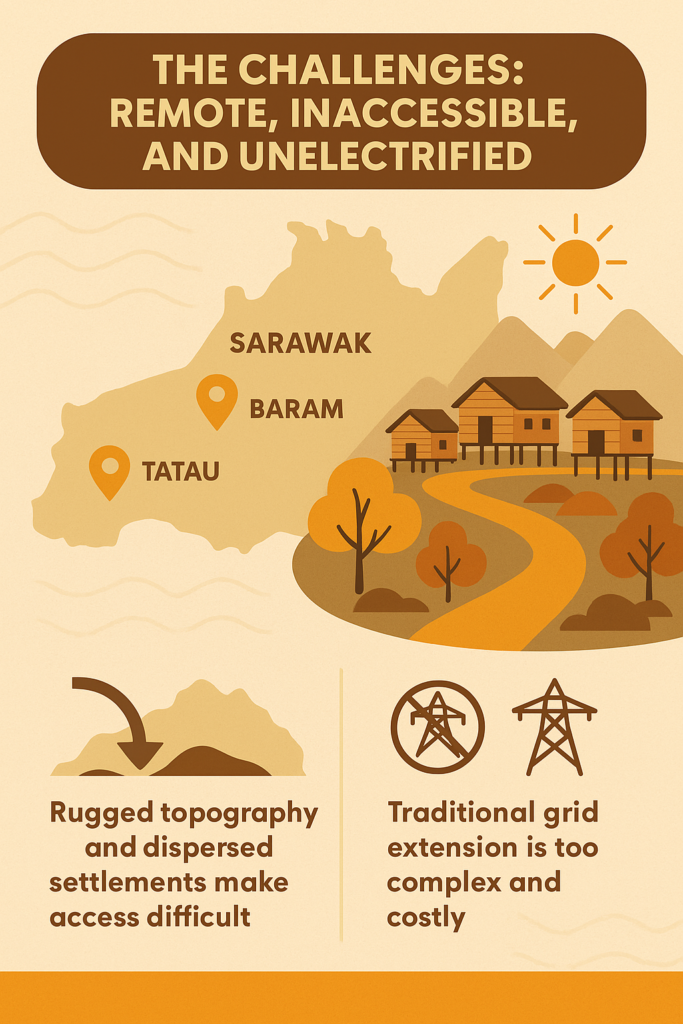
The Challenges: Remote, Inaccessible, and Unelectrified
Sarawak’s rugged topography and widely dispersed settlements make rural electrification a formidable challenge. Many communities, especially in Kapit, Baram and Tatau, and Batang Ai are reachable only by longboat or timber roads. Traditional grid extension is both technically complex and prohibitively expensive.
In 2016, the Sarawak Government, in collaboration with the Federal Government and Sarawak Energy Berhad (SEB), launched SARES to address this electrification gap. With over RM800 million in joint funding, the initiative aims to ensure 100% rural electricity coverage by 2025, five years ahead of the United Nations’ Sustainable Development Goal 7.
The Solution: Scalable, Renewable Solar Energy Systems
At the heart of SARES is solar technology, deployed through two main models: the Centralised Solar Power System (CSPS) and the Solar Home System (SHS).
The CSPS used in most villages features a community based solar farm connected to a centralized battery storage unit inverter housed in a mobile friendly mental clad structure. In extremely remote or scattered settlements, SHS is installed per household, each unit consisting of solar panels, inverter, and batteries.
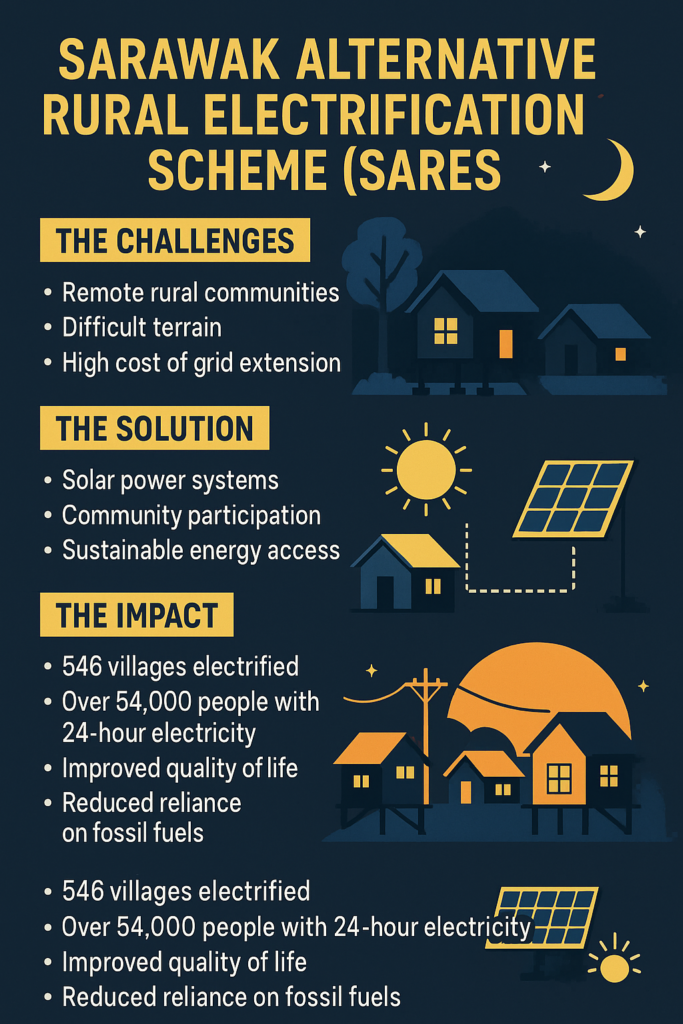
These systems provide up to 2KWh daily enough to power lights, fan, TVs, freezers, and basic electronics. With battery banks capable of storing up to two days’ worth of electricity, and energy limiters installed to regulate usage, the system guarantees reliability and equitable distribution across households.
Sarawak’s equatorial sunlight ensures a consistent energy supply, with each 1kW system generating roughly 1WMh of electricity annually. Most importantly, communities are involved from start to finish assisting with installation, trained in operations, and tasked with maintenance.
Impact: From Darkness to Dignity
As of May 2023, over 54,000 people in 546 villagers have gained access to 24-hour electricity through SARES. This shift has been life changing.
In Kapit, for instance, 2,755 households across 140 villages celebrated the end of a 30 year wait for electricity with the completion of SARES Phase 2. School children can now study in the evening, villagers can craft, sew, or repair nets at night, and families can preserve fish and vegetables using solar powered freezers dramatically improving food quality.
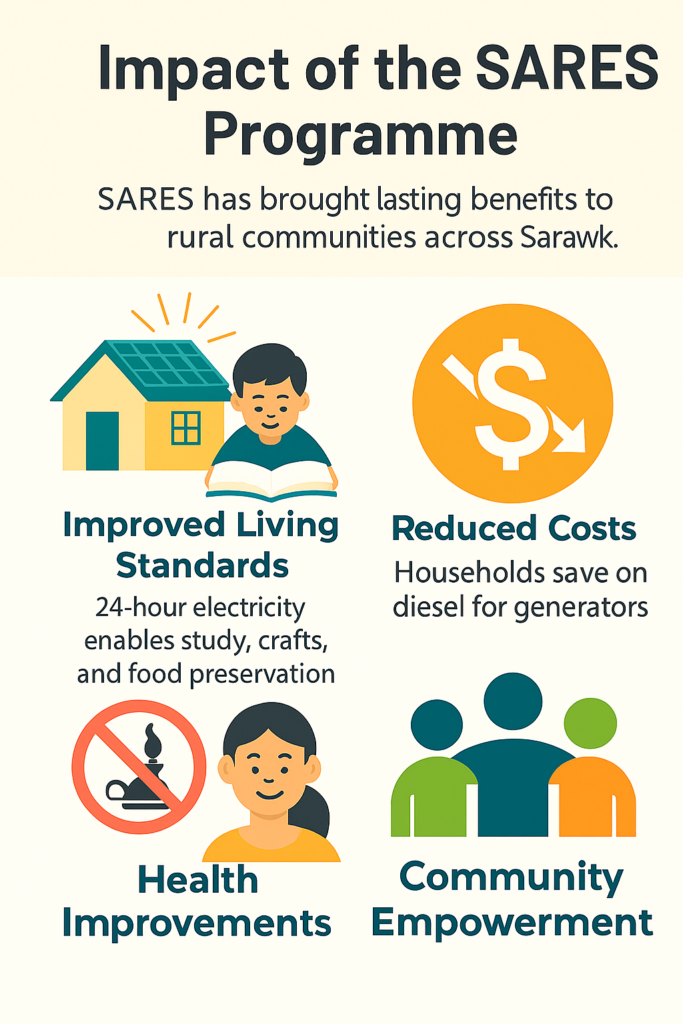
The impact also extends to household economies. Previously, rural households spent RM300–RM400 monthly on diesel to power generators for only a few hours a day. Now, they enjoy free, quiet, and clean energy with zero recurring fuel costs and reduced trips to town for supplies.
Health benefits are also significant. With the elimination of kerosene lamps, families are less exposed to indoor air pollution and fire hazards.
Empowering Communities Through Ownership
Unlike top-down infrastructure projects, SARES embeds sustainability by making communities co-owners of the system. Residents contribute to the building phase through gotong-royong, receive hands-on training in maintenance, and assume responsibility for minor troubleshooting and cleaning of panels.
In Baram, for example, over 128 households in longhouses like Rumah Rok and Rumah Asong now maintain their own solar units. Similarly, in Batang Ai, a separate initiative under Sarawak Energy’s CSR programme introduced Solar Home Systems and communal Solar Freezer System (SFS) to 63 households enhancing food preservation and reducing economic stress.
These efforts not only build energy resilience but also foster technical skills, local pride, and environmental awareness. To date, over 15,000 rural families have directly benefited from the initiative.
Scaling Up: Overcoming Skills GAps and Expanding Reach
Despite its success, Sarawak’s rural solar journey faces one persistent challenge: a shortage of skilled personnel in solar system design. As of late 2023, only 126 certified solar technicians were registered under SARES excluding specialized designers.
To bridge this gap, UNIMAS was accredited to offer Sarawak’s first Solar Photovoltaic System Design Course, with the backing of the Ministry of Utility and Telecommunication. The aim is to cultivate homegrown expertise, reducing reliance on external consultants and accelerating projects delivery.
A Bright Future: Integration, Innovation, and Inclusivity
SARES is not a stopgap but a stepping stone. While immediate efforts focus on expanding standalone solar systems, future plans include connecting SARES villages to the main electricity grid as infrastructure allows and upgrading to hybrid systems in high demand areas. In Bario Highlands, for example, a solar diesel hybrid station now powers over 200 households, with scope for expansion.
The approach is community driven, cost effective, and environmentally sustainable a model that aligns with Malaysia’s broader rural development goals and could be adapted for other state or nations with similar terrain challenges.
Conclusion: A Model of Solution Journalism in Action
SARES exemplifies solution journalism: a clear problem (lack of rural electrification), a replicable solution (solar powered systems), and measurable impact (thousands electrified, cost reduced, skills built).
It not just about bringing power, it’s about restoring dignity, enhancing livelihoods, and closing the urban rural divide. With continued investment, technical training, and community partnership, Sarawak is well on track to achieve energy equity for all its people. One sunlit village at a time.
Reference
Neville Timothy Sanders. (2024, September 30). Kapit Rural Folk Finally Receive Electricity With Completion Of SARES Phase 2 | Sarawak Tribune. New Sarawak Tribune. https://www.sarawaktribune.com/kapit-rural-folk-finally-receive-electricity-with-completion-of-sares-phase-2/
Sarawak Energy – Power To Grow. (n.d.). Sarawak Energy. https://www.sarawakenergy.com/media-info/media-releases/2016/electrification-of-bario-highlands-via-solar-hybrid-power-system
Sarawak Energy – Power To Grow. (2016a). Sarawak Energy. https://www.sarawakenergy.com/sarawak-alternative-rural-electrification-scheme-sares
Sarawak Energy – Power To Grow. (2016b). Sarawak Energy. https://www.sarawakenergy.com/media-info/media-releases/2016/sarawak-energy-lights-up-more-remote-communities-in-batang-ai-with-solar-home-system-shs
Sarawak Energy – Power To Grow. (2018a). Sarawak Energy. https://www.sarawakenergy.com/media-info/media-releases/2018/128-households-in-remote-baram-lighted-up-with-renewable-solar-energy
Sarawak Energy – Power To Grow. (2018b). Sarawak Energy. https://www.sarawakenergy.com/media-info/media-releases/2018/ten-remote-villages-in-tatau-lighted-up-with-renewable-solar-energy
TVS. (2023, September 11). Sarawak perlu lebih ramai tenaga mahir dalam reka bentuk solar – TVS. TVS. https://www.tvsarawak.my/2023/09/11/sarawak-perlu-lebih-ramai-tenaga-mahir-dalam-reka-bentuk-solar/