The brain was once understood to be relatively fixed, with minimal capacity for further adaptation.
In The Brain That Changes Itself, a Canadian psychiatrist and psychoanalyst, Norman Doidge, challenges this long-held belief by introducing neuroplasticity, highlighting the brain’s lifelong ability to reshape itself and build new neural pathways.
Instead of presenting neuroplasticity in abstract terms, Doidge weaves together a series of real-life stories, such as recovery after stroke, resilience in the face of learning challenges, and shifts in perspective among clinicians.
While each chapter stands as its own story, they collectively underscore a powerful message: the brain is ever-changing, shaped by experience, attention, and behaviour.
Throughout the book, Doidge examines multiple facets of the brain’s adaptability, from sensory remapping to post-injury recovery.
When applied to mental health, these ideas become particularly resonant.
Experiences like anxiety and trauma can feel relentless, as if the mind is caught in fixed cycles.
Neuroplasticity challenges this perception, suggesting that these are not permanent traits but adaptable neural pathways.
Among all the chapters, Chapter 6, Brain Lock Unlocked, stands out as relevant to mental health, specifically a type of anxiety disorder called obsessive-compulsive disorder (OCD).
In this chapter, Norman Doidge discusses the work of American psychiatrist and researcher Jeffrey Schwartz, whose behavioural approach to OCD offers insights that extend beyond the condition itself to broader patterns of anxious and trauma-driven thinking.
Schwartz suggests that individuals can reshape their brain activity by learning how to respond differently to intrusive thoughts.
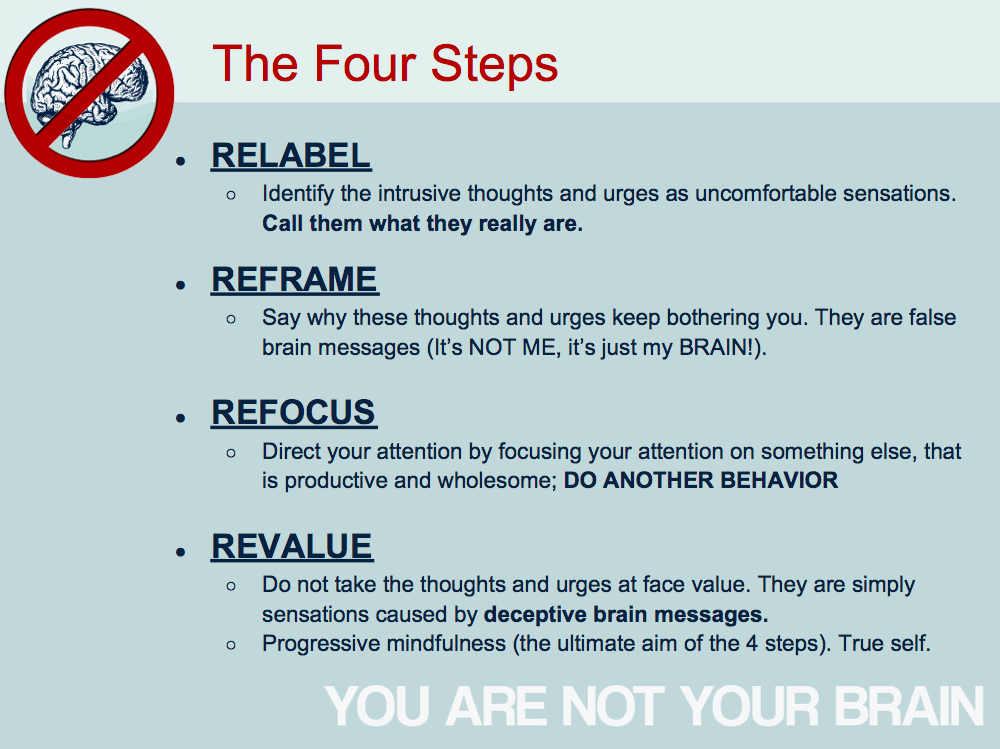
His Four-Step Method, “Relabel, Reattribute, Refocus, and Revalue”, guides individuals to:
- Recognise intrusive thoughts as symptoms, not inherent truths
- Conceptualise them as outcomes of neural processes rather than personal identity
- Gently move your attention away from spiralling or compulsive reactions
- Progressively re-evaluate the perceived significance of these thoughts
This framework fosters psychological distance, allowing individuals to perceive intrusive thoughts as mental events rather than reality.
At the centre of this process is Refocus, the step most closely tied to neuroplasticity.
By consistently redirecting attention away from intrusive thoughts, individuals weaken established neural pathways and reinforce alternative ones.
Do that often enough, and those small shifts will begin to change the way your brain works.
For individuals living with trauma, this idea is especially significant.
Trauma wires the brain toward hypervigilance and fear, making reactions feel automatic.
Therefore, the notion that attention can gradually reshape these patterns restores a sense of agency, something trauma often erodes.
However, such a change is neither immediate nor effortless.
Neuroplasticity depends on repetition, consistency, and often the support of therapy.
When you see it as a gradual process instead of a quick fix, it becomes something steady, realistic, and genuinely empowering.
Overall, The Brain That Changes Itself manages to make neuroscience feel both understandable and full of wonder.
It reframes mental illness not as a fixed identity, but as a collection of patterns capable of change over time.
While the book leans strongly on individual case studies, and some conclusions may feel optimistic in light of neurological complexity, this perspective is not without limits.
Although neuroplasticity is a powerful mechanism, it is not absolute, and recovery is rarely linear.
Nevertheless, the core message stays powerful:
“The brain is not permanently broken—it is adaptable.”
For those carrying anxiety or trauma, this idea can be quietly life-changing.
Book Recommendations
For readers who wish to delve further into neuroplasticity, several non-fiction works explore how the brain evolves through thought, behaviour, and lived experience:
- You Are Not Your Brain by Jeffrey M. Schwartz and Rebecca Gladding
This book focuses on self-directed neuroplasticity, showing how changing the way you respond to intrusive thoughts can, over time, rewire unhelpful brain patterns.
- The Body That Keeps the Score by Bessel van der Kolk
This book describes how trauma affects the brain and nervous system, and how mindfulness and EMDR support neuroplastic healing.
- Rewire Your Anxious Brain by Catherine M. Pittman and Elizabeth M. Karle
This book explores how trauma alters the brain and nervous system, and how approaches such as mindfulness and EMDR can support neuroplastic healing.
At the same time, not everyone connects with theory-heavy writing, especially when the subject carries emotional weight.
Fiction offers an alternative, illustrating how thoughts, emotions, and identities change over time through lived experience.
Some stories quietly mirror the slow rewiring of the brain, tracing how thoughts, emotions, and identities shift over time.
For example:
- I’ll Give You the Sun by Jandy Nelson
This book explores themes of grief, identity, and shifting perception, with dual timelines reflecting how experience reshapes emotional and neural interpretation over time.
- Am I Normal Yet? by Holly Bourne
This book follows OCD and intrusive thoughts in adolescence, showing how the right strategies and support can slowly help reshape those patterns over time.
- Girl in Pieces by Kathleen Glasgow
This book shows trauma recovery as slow rebuilding through environment and relationships.
- Eleanor Oliphant is Completely Fine by Gail Honeyman
This book, from a neuroplasticity perspective, reflects how consistent relational experiences can gradually weaken long-standing neural pathways of avoidance and reinforce new patterns of emotional safety and belonging
To sum it up, The Brain That Changes Itself reframes the brain as a dynamic system shaped by experience rather than a fixed structure.
Chapter 6 really brings this to life, showing how attention and behaviour can slowly reshape neural pathways, especially in relation to anxiety and trauma.
While neuroplasticity is not a cure-all and change is not immediate or guaranteed, it provides a scientifically grounded framework for psychological recovery.
Combined with therapy and support systems, it becomes a powerful lens for healing.